You need financing for a Baltimore rowhouse renovation. The numbers work, the neighborhood’s solid, but you’re stuck on one question: how long do you actually get to complete the project?
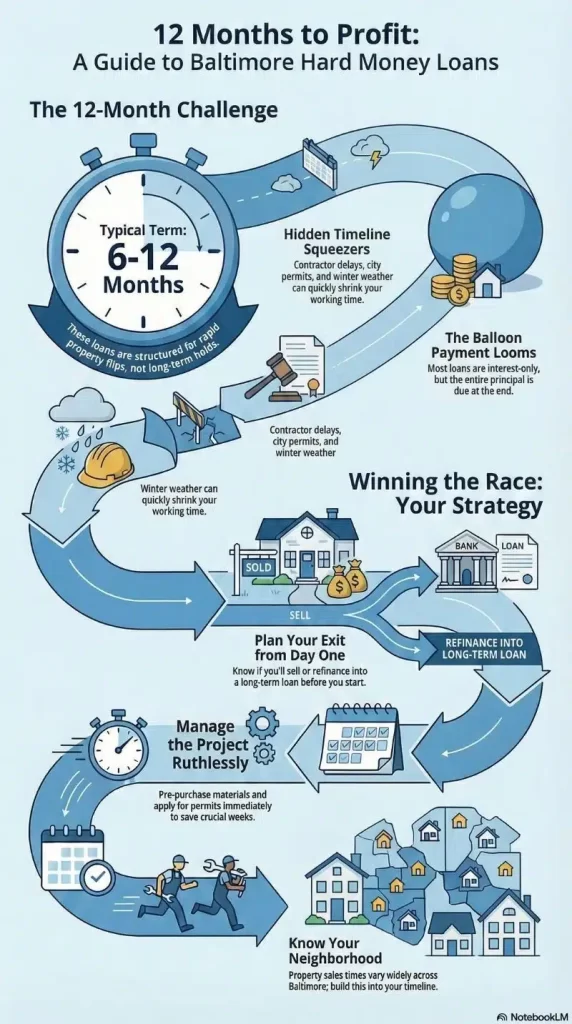
Baltimore hard money loans run anywhere from six months to two years in most cases. The standard term hovers around 12 months, though some lenders push that to 24 months if your project scope demands it. Longer terms exist, but they’re uncommon and usually reserved for specific situations.
Six to twelve months sounds tight. Because it is.
What Drives These Short Timeframes
The lending structure itself explains the compressed timeline. These loans are designed around property flips and quick turnarounds, not long-term holds. Your exit strategy becomes the most important part of the entire transaction.
Lenders structure these products for speed. You acquire a distressed property, renovate fast, then either sell or refinance into permanent financing. The entire business model depends on rapid execution.
Interest-only payments help during the short term. Most Baltimore lenders offer this option, keeping your monthly obligations manageable while you focus on the renovation. But that final balloon payment arrives fast, whether you’re ready or not.
The Real Timeline Pressure
Twelve months sounds reasonable until you break down what actually needs to happen. Finding contractors in Baltimore who understand rowhouse renovation quirks eats up weeks. Permit delays in certain neighborhoods can stretch timelines beyond what any reasonable person would expect.
Winter construction creates additional challenges. Try scheduling foundation work or exterior repairs between November and March in Maryland. Your timeline just shrunk by four months.
Comparable sales complicate the math too. Canton and Federal Hill move differently than neighborhoods further east. Your ARV projections need to account for what’s actually selling, not what Zillow suggests properties might be worth.
When Extensions Make Sense
Some Baltimore investors push for 18 to 24-month terms upfront. Rowhouses with structural complications, properties requiring complete gut renovations, or deals in neighborhoods with slower sales velocity all benefit from longer initial terms.
The extension conversation gets expensive fast. Lenders charge fees for term extensions, and rates typically increase. That extra six months might cost you several thousand dollars in additional interest and penalties.
Better to structure the initial term conservatively. Overestimate your timeline by 25%. Contractors run late. Inspections uncover problems. Materials get delayed. You need buffer time built into the original agreement.
Baltimore-Specific Timing Considerations
Market absorption rates vary wildly across Baltimore neighborhoods. Properties in Mount Vernon or Harbor East typically sell within 30 to 60 days once listed. Move into East Baltimore or certain parts of West Baltimore and that timeline extends to 90 days or longer.
Rowhouse appraisals take time. Finding truly comparable sales for a renovated property in a transitional neighborhood requires an appraiser who knows Baltimore intimately. Rush this process and your ARV gets challenged during the sale.
Seasonal patterns affect everything. Spring and early summer bring the strongest buyer activity. List a renovated property in December and you might sit through winter waiting for offers.
The Exit Strategy Calculation
Your payoff plan determines whether a 12-month term works. Refinancing into a DSCR loan requires rental income documentation, which means finding tenants, collecting rent, and demonstrating cash flow. That sequence takes months.
Selling requires different timing. Renovation completion, final inspections, listing preparation, marketing time, negotiation periods, and buyer financing delays all stack up. Three months from “renovation complete” to “closing check in hand” is optimistic.
Most successful Baltimore investors work backward from their exit date. They calculate every step required to exit the loan, then add 60 days. Only then do they consider whether the loan term actually fits their project.
What Longer Terms Actually Cost
Extended terms come with tradeoffs. A 24-month loan might carry higher interest rates or require larger down payments. Lenders price the additional risk into the deal structure.
Points increase with term length in some cases. A standard 12-month loan might cost two to three points. Push that to 24 months and you could see four or five points upfront.
The math changes completely when you factor in holding costs. Every extra month means additional insurance, utilities, taxes, and opportunity cost. Sometimes a slightly higher rate on a shorter term actually saves money compared to a longer, “cheaper” loan.
When Traditional Timeframes Don’t Fit
Some Baltimore projects genuinely need more than 24 months. Major structural work, historic property renovations, or properties with environmental remediation requirements don’t fit standard hard money terms.
Bridge loans serve a different purpose in these situations. They fill gaps between acquisition and permanent financing, typically running 12 to 36 months with different qualification criteria.
Construction loans offer another path for ground-up projects or complete rebuilds. These products structure draws around construction milestones rather than simple monthly interest payments.
How Your Experience Affects Terms
First-time flippers in Baltimore face tighter constraints. Expect 12 months maximum, possibly less. Lenders want to see you execute quickly when you lack a track record.
Experienced investors gain flexibility. Three completed projects in Baltimore opens conversations about 18 or 24-month terms. Ten successful flips and you might negotiate custom term structures.
Your relationship history matters too. Repeat transactions with the same lender create opportunities for better terms, extended timelines, or reduced fees. The fourth deal looks different from the first.
Market Conditions Change Everything
Baltimore’s lending environment shifts with broader economic forces. When money flows freely, lenders extend longer terms and compete on flexibility. When capital tightens, terms shorten and requirements stiffen.
The foreclosure situation affecting certain neighborhoods influences lender appetite too. Areas experiencing distress face stricter scrutiny and potentially shorter terms. Lenders want faster exits when market stability seems uncertain.
Interest rate environments also play a role. Rising rates compress terms as lenders reduce their exposure to rate risk. Stable or falling rates might extend the standard offerings.
Making the Timeline Work
Success with short-term Baltimore hard money loans requires ruthless project management. Your general contractor needs to understand the urgency. Every delay compounds.
Pre-purchasing materials helps. Lock in prices and availability for major items before closing the loan. Waiting until after you own the property to order cabinets or HVAC systems adds weeks you don’t have.
Permit applications should start immediately. Don’t wait for closing. Get the paperwork moving so you’re ready to pull permits the day you take possession.
The Refinance Option
Many Baltimore investors use hard money as a bridge to permanent DSCR financing. Complete the renovation, find a tenant, document 30 to 60 days of rental income, then refinance into a 30-year fixed product.
This strategy extends your actual hold period far beyond the hard money term. But it requires planning the exit strategy from day one. The property needs to qualify for DSCR financing, which means meeting specific debt service coverage ratios.
Appraisal value becomes crucial during refinance. The permanent lender orders a new appraisal based on the renovated, income-producing property. If that value falls short, your refinance fails and the hard money loan comes due.
Real Numbers From Baltimore’s Market
Current Baltimore hard money loans average around 10% to 11% interest with terms between six and 18 months. Average loan amounts sit around $295,000 to $322,000, reflecting the city’s property values and typical renovation scope.
Origination fees typically run three to four points. On a $200,000 loan, that’s $6,000 to $8,000 upfront. Combined with your down payment requirement of 15% to 30%.
Monthly interest-only payments on that $200,000 loan at 10.9% run about $1,817 for example.
Why The Short Timeline Exists
Lenders price these products for risk and speed. Every month your loan remains outstanding creates exposure to market changes, borrower circumstances, and property condition issues.
The business model depends on capital velocity. Money out for 12 months can support three different deals across three investors. Money tied up for 36 months serves one deal while opportunity cost accumulates.
Regulatory considerations factor in too. Shorter-term commercial loans face different compliance requirements than longer consumer products. Keeping terms under 24 months helps lenders navigate various regulatory frameworks.
What You Control
Your preparation determines whether a 12-month term creates stress or provides plenty of cushion. Detailed project plans, realistic timelines, and conservative budgets make short terms manageable.
Contractor selection might be the single most important decision. A general contractor who delivers on schedule transforms a tight 12-month window into a comfortable timeline. One who runs 30% behind schedule makes that same window impossible.
Your market knowledge matters enormously. Understanding which Baltimore neighborhoods absorb renovated properties quickly versus which require patience affects whether you should even attempt a short-term flip in a particular area.
The term length isn’t arbitrary. It reflects the realities of property flipping economics, lender risk tolerance, and market dynamics. Work within these constraints or structure your deals differently.
Most Baltimore investors find 12 to 18 months sufficient for standard rowhouse renovations. Properties requiring extensive work need longer terms or alternative financing structures. Know which category your project falls into before you commit to a specific loan term.