You’ve found a Baltimore rowhouse priced at $180,000 that needs $50,000 in renovations. After running the numbers, you know the deal works. But when you start exploring financing, the payment structure raises questions you hadn’t considered.
Hard money loans absolutely have monthly payments. But the structure differs from what most investors expect when they’re used to conventional financing.
Interest-Only Payment Structure
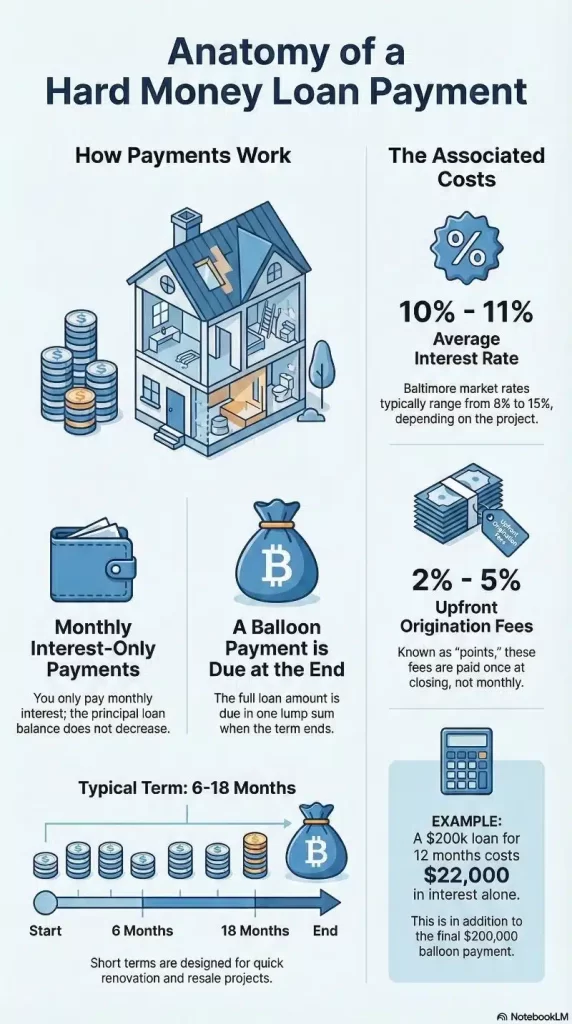
Baltimore hard money loans operate on interest-only payments during the loan term. You pay only the interest portion each month, not the principal balance. The full loan amount comes due at the end of the term, typically in a lump sum payment called a balloon payment.
Take a $200,000 hard money loan at 11% annual interest. Your monthly payment would run around $1,833. That entire payment covers interest accrued during the previous month. The principal balance stays untouched until the loan matures.
This approach solves a fundamental cash flow problem for fix-and-flip investors. When you’re buying a rowhouse in Canton for renovation and resale, you can’t generate income from the property during construction. Interest-only payments keep your monthly obligations manageable while work progresses.
How Baltimore Market Rates Affect Your Payment
Current Baltimore hard money lending runs between 8% and 15%, with most loans clustering around 10% to 11%. These rates fluctuate based on your experience level, the property’s condition, and loan-to-value ratio.
Real numbers from the Maryland market tell the story. A $322,000 loan at 10% interest generates monthly payments of approximately $2,683. At 12%, those same payments jump to $3,220. Rate differences that seem minor on paper translate into meaningful monthly obligations.
Location matters too. A Federal Hill renovation might qualify for better terms than a property in less established neighborhoods. Distance from Camden Yards, property condition, and comparable sales all influence the rate your lender quotes.
Term Length Changes Everything
Most Baltimore hard money loans run six to eighteen months. Some lenders extend terms to 24 months, but shorter durations dominate the market.
Six-month terms work for straightforward cosmetic renovations. Twelve months provides breathing room for more complex projects involving structural work or permit delays. Longer terms cost more but reduce pressure when construction hits unexpected complications.
Consider the same $200,000 loan under different scenarios. A six-month term at 11% costs roughly $11,000 in total interest. Stretch that to twelve months and interest doubles to $22,000. Every additional month on a hard money loan adds cost.
Baltimore’s seasonal construction patterns affect planning. Starting a major renovation in November means winter weather could push timelines into spring. Smart investors factor seasonal delays into their term length decisions.
The Balloon Payment Reality
When your loan matures, the full principal comes due. On a $200,000 loan, you’ll owe $200,000 regardless of how many interest payments you’ve made.
Most investors plan three potential exits. First option: sell the renovated property and use proceeds to pay off the loan. Second option: refinance into conventional financing if you’re keeping the property as a rental. Third option: secure another hard money loan if the project needs more time.
That balloon payment isn’t negotiable and it doesn’t get smaller over time. Your exit strategy needs to be solid before you close on the loan.
Origination Fees & Points Impact Upfront Costs
Beyond monthly payments, Baltimore hard money lenders charge origination fees ranging from 2% to 5% of the loan amount. These fees get paid at closing, not monthly.
A $200,000 loan with 3 points means $6,000 due upfront. Some lenders allow rolling these costs into the loan amount, but that increases your balloon payment and monthly interest.
Points represent a one-time charge. Monthly payments cover only ongoing interest accrual. Keep these costs separate in your calculations.
Payment Timing & Proration
Monthly payments typically start on the first of the month following your closing. If you close on January 15th, most lenders prorate interest for those partial days. Your first full payment wouldn’t hit until March 1st.
This timing matters for cash flow planning. You get roughly 45 days before that first payment comes due, giving you time to start renovations and establish your project rhythm.
Some lenders autodraft payments on the first. Others give you a grace period. Know your lender’s specific requirements before closing.
How Prepayment Works
Baltimore market lenders split on prepayment penalties. Roughly half charge no penalty if you pay off the loan early. The other half include prepayment terms in their contracts.
Prepayment penalties typically apply if you pay off the loan within the first three to six months. These penalties compensate lenders for lost interest income when loans close faster than expected.
Read your loan documents carefully. Some lenders waive prepayment penalties if you refinance with them into a long-term rental product. Others charge flat fees or percentage-based penalties regardless of circumstances.
Comparing Payment Structures Across Loan Types
Traditional mortgages amortize principal and interest together. Each payment chips away at what you owe. After 30 years, you own the property free and clear.
Hard money flips that model. You’re not building equity through monthly payments. Instead, you’re maintaining the loan while the property’s value increases through renovation.
Bridge loans sometimes offer hybrid structures. A few lenders provide partial amortization where some principal gets paid down monthly. But pure interest-only dominates Baltimore’s hard money market.
What Happens If You Miss a Payment
Late payments trigger penalties that vary by lender. Typical late fees run 5% of the monthly payment after a grace period of 10 to 15 days.
Default situations escalate quickly with hard money loans. Unlike conventional mortgages where lenders work through lengthy foreclosure processes, hard money lenders can move faster to protect their investment.
Miss multiple payments and you risk losing the property. The lender’s security interest in the real estate allows them to foreclose and recoup their capital. Your renovation investment and any equity disappears in that scenario.
Baltimore-Specific Payment Considerations
Rowhouse renovations create unique timing challenges. Shared wall issues with neighbors can delay work. Historic district approvals take time. Winter weather shuts down exterior work for weeks.
Your monthly payment doesn’t pause when construction stalls. Budget for at least two extra months beyond your planned timeline. If you think a renovation takes six months, get an eight or nine-month loan term.
Properties near Harbor East or Fells Point might command premium resale prices, but they also face stricter renovation regulations. Factor permit delays into your payment timeline planning.
Making the Numbers Work
Start with your target property’s purchase price. Add renovation costs. Include holding costs like utilities, insurance, and yes, those monthly interest payments.
Calculate total interest by multiplying your loan amount by the annual rate, then dividing by 12 for each month you’ll hold the loan. A $200,000 loan at 11% for nine months costs approximately $16,500 in interest alone.
Add origination fees. Factor in your down payment requirement, usually 15% to 25% of the purchase price. Now you see the full capital requirement.
Your after-repair value needs enough cushion to cover all these costs plus your profit margin. If the numbers don’t work with hard money financing, the deal itself might not work.
When Interest-Only Payments Make Sense
Fix-and-flip investors benefit most from interest-only structures. You’re not generating rental income during renovation. Keeping monthly obligations low preserves capital for construction costs and unexpected issues.
BRRRR investors sometimes use hard money for the initial purchase and renovation phases. Once the property stabilizes with tenants, they refinance into conventional financing with lower rates and traditional amortization.
New construction projects occasionally use hard money for land acquisition or early construction phases. But longer timelines make conventional construction loans more cost-effective for ground-up development.
Alternative Payment Structures
Some lenders offer deferred interest where payments don’t start until month three or four. This gives you time to begin renovations before cash flow obligations hit.
Accrued interest models add monthly interest to the principal balance instead of requiring payments. At loan maturity, you owe the original principal plus accumulated interest. This structure works when you need maximum cash preservation during construction.
Both alternatives cost more in total interest. They solve short-term cash flow problems by increasing long-term obligations.
Payment Planning for Multiple Properties
Experienced investors running several simultaneous renovations face stacked monthly obligations. Three properties with $2,000 monthly interest payments each means $6,000 in total monthly debt service before accounting for other holding costs.
Cash reserves become critical. Keep enough liquid capital to cover three months of payments across all properties. Construction delays happen. Market conditions shift. Buyers back out of contracts.
Your payment obligations don’t care about your sales timeline. Plan conservatively and maintain backup capital sources.
The Exit Strategy Connection
Monthly payments only matter because of the balloon payment deadline. You’re essentially renting money from the lender with a firm return date.
Sell too early and you might leave profit on the table. Hold too long and additional interest payments eat into returns. Refinancing takes time and costs money.
Map your exit strategy before your first payment comes due. Know your backup plans. Understand how long you can sustain monthly payments if your primary exit hits delays.
Baltimore’s real estate market moves differently than national trends. Local buyer demand affects your ability to exit through sale. Rental market conditions influence refinancing options.
Hard money monthly payments function as a cost of doing business. Keep them as low as possible through competitive rate shopping. Minimize them through efficient project execution. But never forget they’re accumulating while you work toward that profitable exit.